The Great Reset: 5 Surprising Realities Reshaping Tech and Security in 2026
1. Introduction: The Year the Future Stopped Waiting
For a decade, the technology sector moved to the steady, predictable drumbeat of incrementalism: iterative software updates, cautious pilot programs, and the long-horizon promise of “digital transformation.” In 2025, that cadence has effectively shattered. We have reached a strategic inflection point where the era of experimentation has ended, and the era of fundamental restructuring has begun.
The “innovation fatigue” that long plagued the C-suite—the exhaustion born of chasing hype cycles with nebulous ROI—is being replaced by a sense of urgency. 2025 is not a mere continuation of previous trends; it is a “Great Reset.” The infrastructure of the global economy is being rebuilt, bought, and powered at a scale that suggests the future is no longer content to wait.
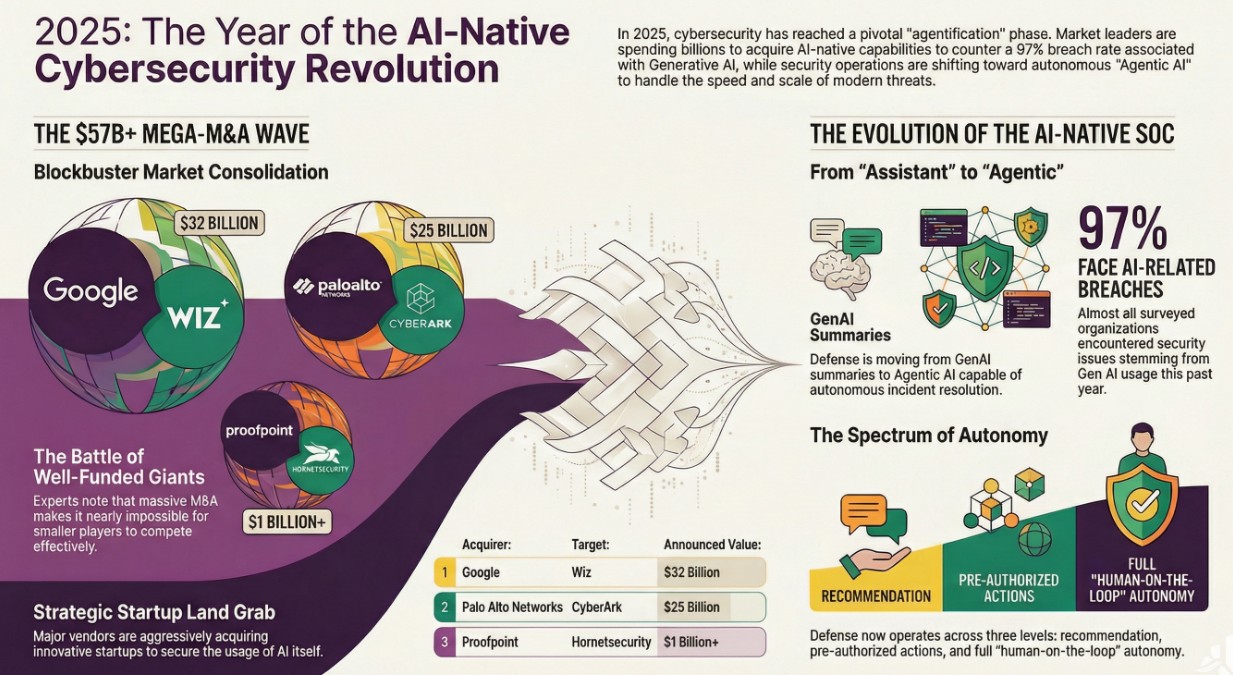
2. The $32 Billion Validation: Mega-M&A and the End of the “Small Player” Era
The cybersecurity market has undergone a violent transition from fragmentation to aggressive “platformization.” This is no longer a market of niche solutions, but a battle of well-funded, large-scale titans. Two distinct M&A strategies have emerged: high-level consolidation and precision innovation hunting.
The industry’s “blockbuster” deals signify the arrival of mega-scale consolidation. Google’s unprecedented $32 billion acquisition of Wiz and Palo Alto Networks’ $25 billion move for CyberArk represent more than just market share grabs; they are strategic plays to dominate the foundational layer of enterprise security. For the CIO, this platformization offers a double-edged sword: the promise of a unified, less complex security stack balanced against the significant strategic risk of vendor lock-in.
Simultaneously, we are seeing “Innovation Hunting”—a race to acquire the specialized AI-native DNA required for modern defense. Recent deals, such as CrowdStrike’s $290 million acquisition of Onum and F5’s $180 million purchase of CalypsoAI, highlight how giants are rapidly absorbing startups to secure AI data pipelines and establish guardrails for generative models.
“This is becoming a battle of well-funded, large competitors. [Such deals make it] difficult for some of these smaller players to compete effectively against these large players.” — Neil MacDonald, Vice President and Distinguished Analyst at Gartner
3. Beyond the Copilot: The “Dawn of Agentification”
If 2023 was the year of the chatbot and 2024 was the era of the “Copilot,” 2025 marks the true “dawn of agentification.” We have moved beyond basic Large Language Model (LLM) interactions into the realm of autonomous “Super Agents” and Multi-Agent Systems (MAGS).
As noted by Andrew Ng, Founder of DeepLearning.AI, the industry is discovering that agentic workflows are driving significantly more progress this year than the development of the next generation of foundational models. We are transitioning from systems that suggest to systems that execute. This shift is defined by a three-level spectrum of autonomy:
- Level 1: Recommendation Engine: The agent provides a clear course of action, but the human remains the final decision-maker.
- Level 2: Automated Actions: The agent is pre-authorized to execute low-risk, well-defined tasks (e.g., blocking a known malicious IP) without waiting for human approval.
- Level 3: Full Autonomy: A “human-on-the-loop” model where agents detect, investigate, and resolve complex incidents independently, utilized primarily in high-stakes environments where speed is the only viable defense.
4. The Silicon-to-Uranium Pivot: Why AI is Bringing Nuclear Back
One of the most counter-intuitive realities of 2025 is the unbreakable bond between cutting-edge AI and one of the world’s oldest carbon-free energy sources: Nuclear power. This resurgence is driven by a brutal collision between AI’s massive energy requirements and corporate Environmental, Social, and Governance (ESG) targets.
Tech giants are currently facing a crisis of sustainability; Microsoft’s carbon emissions have climbed 29% since 2020, while Google’s have surged 49%. To save their climate pledges while feeding the AI beast, the industry is pivoting toward nuclear as the only dependable, climate-independent power source capable of sustaining data center loads.
This is not a theoretical shift. We are seeing a cascade of massive validation deals:
- Microsoft has secured a 20-year deal with Constellation Energy to resurrect a unit at the Three Mile Island plant in Pennsylvania.
- Google has partnered with Kairos Power to deploy a fleet of Small Modular Reactors (SMRs).
- Amazon is actively funding the construction of multiple SMRs to provide localized, scalable power for its cloud infrastructure.
This corporate movement aligns with a broader geopolitical shift. At COP28, 25 countries—including the U.S. and the UK—signed a declaration to triple global nuclear capacity by 2050. In the “Great Reset,” the path to the silicon future runs directly through uranium.
5. The Paradox of the AI Shield: A 97% Breach Reality Check
The adoption of AI in cybersecurity has created a dangerous paradox: the same technology used to build the shield is being used to sharpen the sword. 2025 has turned cybersecurity into an “arms race” of frequency rather than just intensity.
According to the Capgemini Research Institute’s October 2024 survey, the reality of this transition is stark:
97% of organizations have faced breaches or security issues related to the use of Generative AI in the past year.
While 57% of organizations believe GenAI will eventually improve their threat analysis, the democratization of cybercrime means that even small, low-sophistication criminal groups can now launch enterprise-grade attacks.
“We used to ask if organizations would suffer a cybersecurity breach. Now, in the age of Gen AI, it is no longer a matter of if, nor when, but how often.” — Marco Pereira, Executive Vice President, Global Head Cybersecurity, Capgemini
6. From “Whack-a-Mole” to Proactive Hunting: The AI-Native SOC
The traditional Security Operations Center (SOC) is dying. For years, analysts have been trapped in an unwinnable game of “whack-a-mole,” drowning in a flood of manual alerts. 2025 marks the rise of the AI-native SOC, which replaces reactive defense with autonomous, proactive threat hunting.
The centerpiece of this shift is the Multi-Agent System (MAGS). Instead of a single tool, specialized agents—each dedicated to specific functions like malware analysis, data containment, or threat detection—collaborate to resolve complex incidents in real-time.
This evolution is fundamentally “democratizing knowledge.” By using natural language prompts, junior analysts can now query massive threat intelligence databases and perform complex investigations that once required a veteran’s intuition. In this symbiotic model, the “grind” of data processing is handled by agents, allowing human leaders to focus on high-level strategic resilience and the validation of autonomous actions.
7. Conclusion: The Next Era of Resilience
The Great Reset of 2025 has recalibrated the relationship between human intelligence and artificial autonomy. We have moved past the novelty of AI and into a period where the winners will be defined by their ability to operationalize these systems at scale while managing the risks of platform consolidation and energy scarcity.
As we grant “Super Agents” more freedom to act on our behalf, we are forced to confront a new strategic mandate. The question for 2025 and beyond is no longer about what the technology can do, but how we will govern it. As we deploy autonomous systems to protect our most critical infrastructure, how do we ensure the ethical responsibility of these agents keeps pace with their speed?